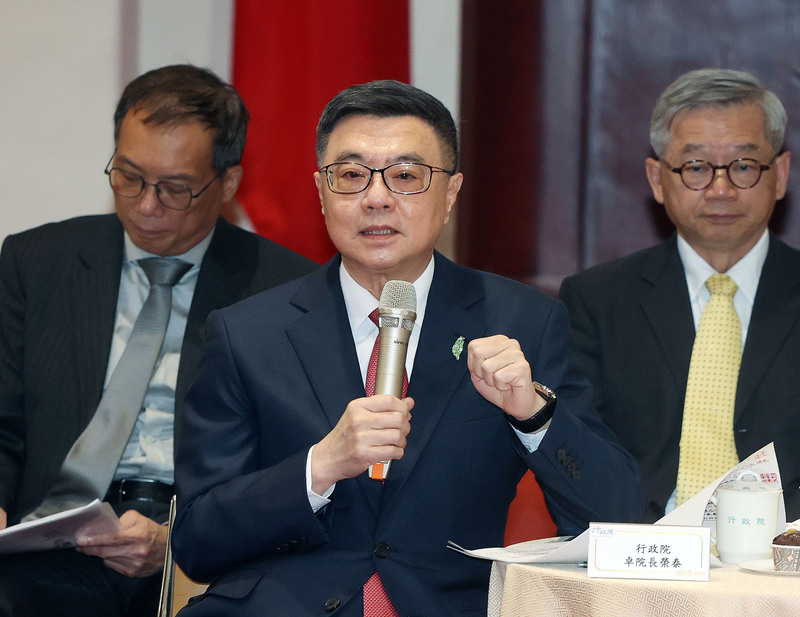
Friday marked the one-year anniversary of Premier Cho Jung-tai (卓榮泰)’s time in office. In the lead up to President Lai Ching-te (賴清德)’s inaugural anniversary, the premier held a tea event with the media to review the administration’s progress.
Reviewing the administration’s progress, Cho touched upon their work on a variety of social projects, including the Hualien earthquake reconstruction, improving pedestrian safety, combating fraud, expanding public daycare and increasing childcare subsidies, as well investing NT$10 billion (just over US$331 million) into new cancer drugs. He also highlighted the administration's economic achievements, such as revitalization work with small- and medium-sized enterprises, investing in tech development like in the AI sector, and the establishment of the NT$10 billion Youth Overseas Dream Fund.
Cho noted that although the public may have the impression that many bills have been brought back for review, this is only the normal constitutional checks and balances in use. He continued that the Cabinet has a constitutional responsibility to review laws, such as the general budget, and progress is being achieved, as well as a balance of power in turbulent times.
As for where they stand currently, Cho said that an industrial support plan to deal with tariffs, including the Taipower subsidy, has been submitted. He thanked the eight major industrial and commercial groups for their support, while expressing hope that the Legislature would follow suit and pass the special budget bill as soon as possible.
Looking forward, Cho announced the government’s “1+7” key tasks, which involve promoting Taiwan’s six major industrial and living areas, establishing the Asia Asset Management Center, and the implementation of a trillion-dollar investment plan. The +1 also refers to establishing the new Sports Ministry, currently set for September 9 of this year.
Other areas of interest include the continued promotion of semiconductor, drone, and smart robot development, putting into use Lai’s 17 national security measures, and the Long-Term Care 3.0 plan. In addition to stabilizing power supplies, the administration is working on phasing out coal-powered power generation by 2032.
Cho closed by underlining that the goal of every administration is to make steady progress for the benefit of all Taiwanese people, and once again called on all members of the government to help build a stronger and more stable society.