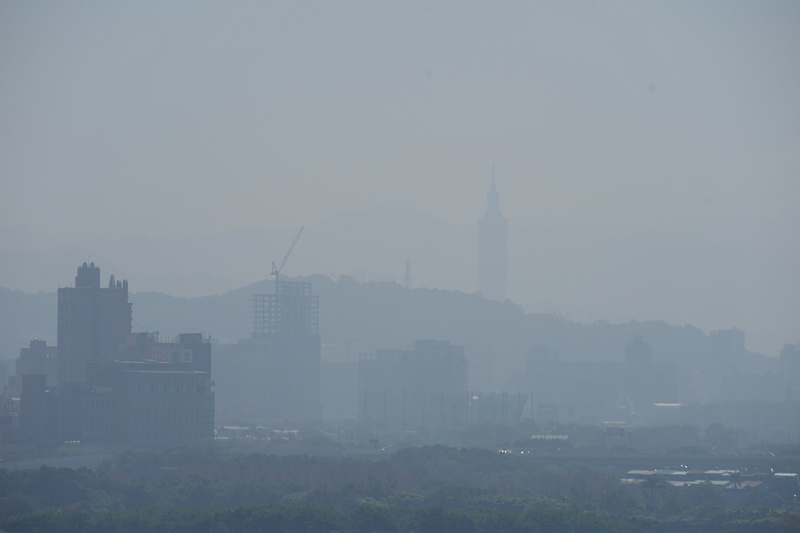
The Environment Ministry released a new air quality policy white paper on Friday to function as the core guide for the third phase of the air pollution control program. The paper lists a total of 62 specific tasks for the future, striving to reduce the annual average PM2.5, or fine particulate matter less than 2.5 microns in size, to 10 micrograms by 2030.
Through government opinion portals, the white paper collected 570 suggestions from the public and experts, showing that the public is most concerned with pollution sources from transportation, followed by industrial, and thirdly, daily life.
Environment Ministry Atmospheric Environment Department Director Huang Wei-ming (黃偉鳴) pointed out that the white paper sets an air quality vision with a health-oriented approach. He said that, in addition to improving pollutant-level warning and response, it also focuses on the air rights of children and sensitive groups, highlighting that raising school campus air quality requires nearby industrial areas to actively reduce emissions. Huang elaborated that special emphasis is being placed on transportation and daily life sources, including added penalties for illegal vehicle modifications, increased inspections, and pollution output control of construction machinery.
Environment Minister Peng Chi-ming (彭啓明) said that the main difference from past papers is that this most recent one is based on science and public opinion. He detailed that through cross-departmental cooperation, the 62 tasks include 26 new or revised regulations. Peng underscored that the paper will also promote an amendment to the Air Pollution Control Act in the hope that the annual average PM2.5 will drop to 10 micrograms by 2030 and to 8 micrograms by 2035.