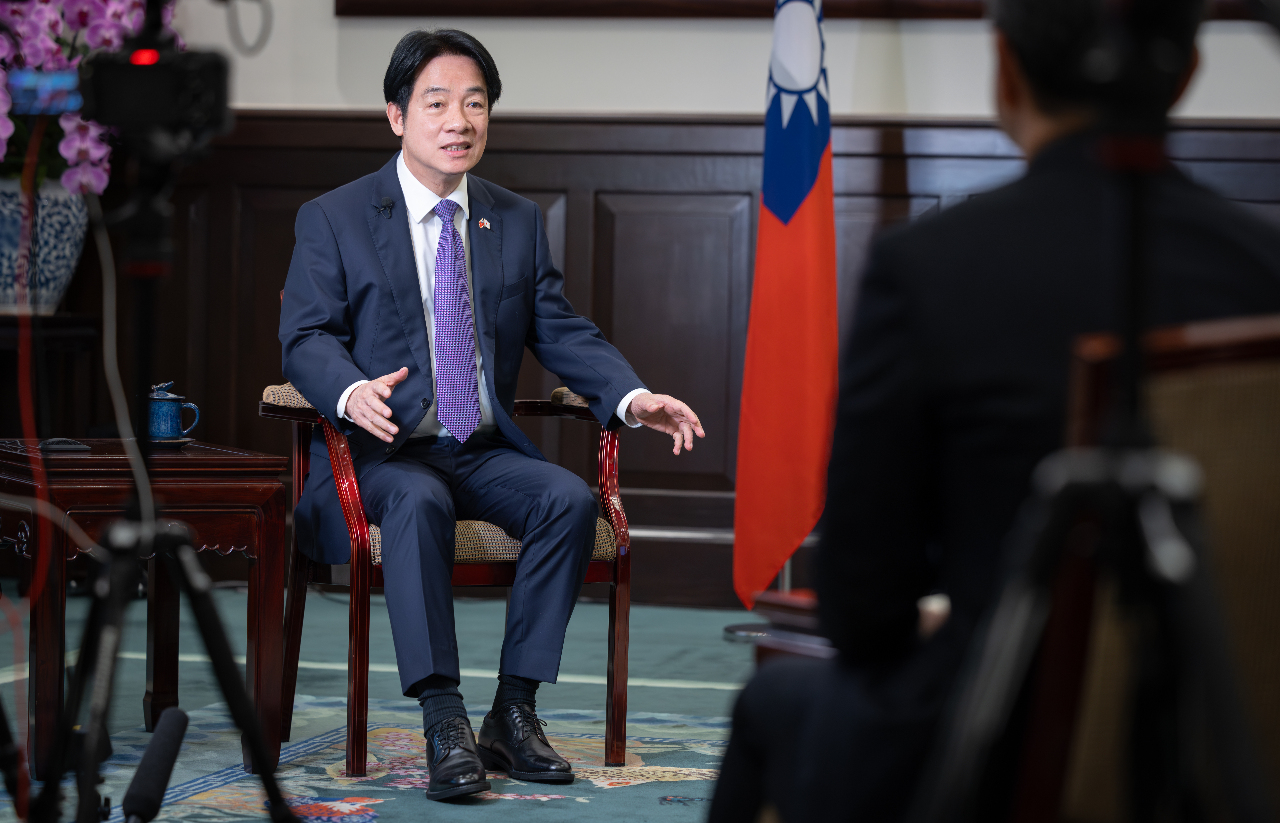
President Lai Ching-te (賴清德) urged the international community to use “non-red” supply chains to counterbalance China’s “unfair” trade, in a Nikkei Asia interview on Tuesday.
With U.S. President Trump's tariff policy putting pressure on governments around the world, Lai detailed that Taiwan’s strategy is to focus on building supply chains with democratic countries. He said that it is a “fundamental question of values,” and the biggest crisis now is that China is using the free trade system to engage in plagiarism and counterfeiting, infringing on intellectual property rights, and dumping low-priced goods around the world.
Lai stated that his administration hopes to use Taiwan's advantages in production and manufacturing to connect democratic societies and establish a global semiconductor supply chain that does not include China. He emphasized that this will ensure future prosperity and that free trade will continue without being affected by dumping.
The President also pointed out that Taiwan's situation is different from other countries because there are direct threats from China's ambition to annex Taiwan. Lai emphasized that if a war breaks out in the Taiwan Strait, it would be provoked by China. He added that the United States also feels threatened by China and needs to redevelop its industry to remain competitive, emphasizing that Taiwan's technological strength and investment can help Washington achieve its goals and ensure Taiwan's long-term development.
Although President Lai stated that he seeks to strengthen the ability of Taiwan and other democratic countries to counter Beijing, he talked about his willingness to build a different future with China. He said that he has not given up such an idea and that as long as there is equality, dignity, exchange, and cooperation, the goodwill of choosing dialogue instead of confrontation and choosing communication instead of containment will always exist.
In response to the interview, DPP Legislative Caucus Secretary-General Rosalia Wu (吳思瑤) affirmed President Lai's strategic vision of democratic alliance, saying that he clearly conveyed how it is necessary to deepen cooperation and strengthen the economic and trade ties of the democratic camp, which are the key to ensuring the stability of the Indo-Pacific.
However, KMT Legislative Caucus Leader Fu Kun-chi (傅崐萁) pointed out that many small and medium-sized enterprises in Taiwan still rely on the Chinese market, with exports still as high as NT$3 trillion (US$98.5 billion) per year. He called on the Lai administration to give priority to the survival of domestic businesses, demanding that the interests of the Taiwanese people and industries be the primary principle in negotiations with the United States.