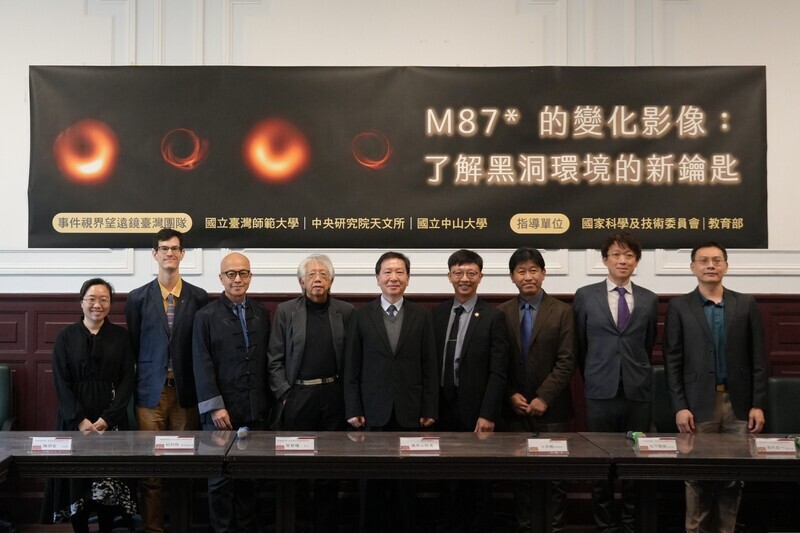
Of the eight telescopes being used by the Event Horizon Telescope (EHT) research team around the world, Taiwanese scientists are responsible for over half of the operation or construction efforts. At a press conference this Thursday, participating researchers from Academia Sinica and National Taiwan Normal University (NTNU) shared some details about Taiwan’s contributions to black hole research.
Britton Jeter, a postdoctoral fellow at Academia Sinica’s Institute of Astronomy and Astrophysics, said Taiwanese scientists participated in the EHT analysis of the supermassive black hole at the center of the Messier 87 (M87) galaxy back in 2017. In 2019, they released the first ever image of a black hole. In this most recent study, the EHT used the observation data they collected in 2017 and 2018 to propose a new theoretical perspective on black holes.
Assistant professor of physics at NTNU Pu Hung-yi (卜宏毅) explained that the EHT team sought to discover why the images of the M87 black hole evolve over time, and how these changes can deepen understanding of the processes involving black holes and their environments. Through their research, EHT were able to uncover new insights into the structure and dynamics of M87's event horizon.
According to the institute’s GLT/VLBI Support Scientist Huang Chi-wei Locutus (黃智威), Taiwanese scientists have worked on the the Sub-Millimeter Array (SMA) and the James Clerk Maxwell Telescope (JCMT) in Hawaii, the Greenland Telescope (GLT) in Greenland, and the Atacama Large Millimeter/submillimeter Array (ALMA) in Chile. Other EHT telescopes are located in Mexico, Spain, the South Pole, and the U.S. state of Arizona.