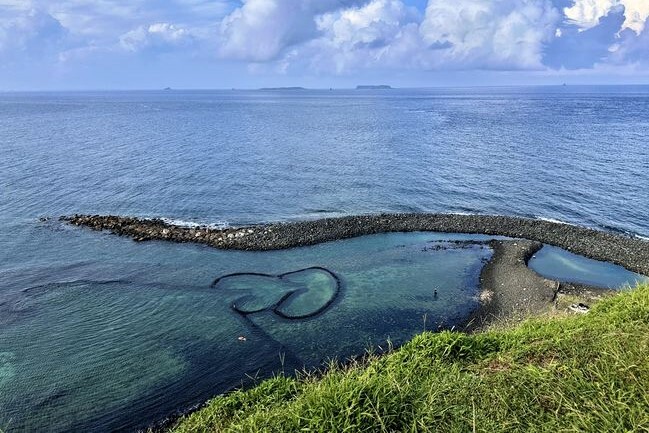
Qimei Island, which is one of Taiwan’s most famous Penghu Islands, has been attracting visitors from all over the world to its fish weirs since the 1980s. As an outstanding expression of underwater cultural heritage, the ancient rock structures known as shí hù (石滬) in Chinese have staked Penghu’s claim to its history.
Built of basalt, coral and limestone in a range of geometric shapes like hearts, horseshoes or arrows, the tidal weirs have been observed in Taiwan for hundreds of years. Between 350 feet and 2 miles in length, these large stone walls once functioned to harvest more than 1,000 pounds of fish and other marine resources for food.
Fishing with weirs fell out of use in the 1960s for a variety of reasons from modernization, globalization and emigration to commercial fishing, overfishing and capitalization. The mariculture tools have been able to survive to the present day as tourist attractions and study sites for marine ecological conservation.
Today, more than 500 weirs remain scattered across the 90 islands and islets that make up the Penghu Archipelago. The iconic monuments also called ‘agriculture at sea’ thus represent one of the largest concentrations of marine archaeology and most well-preserved sites in the world.