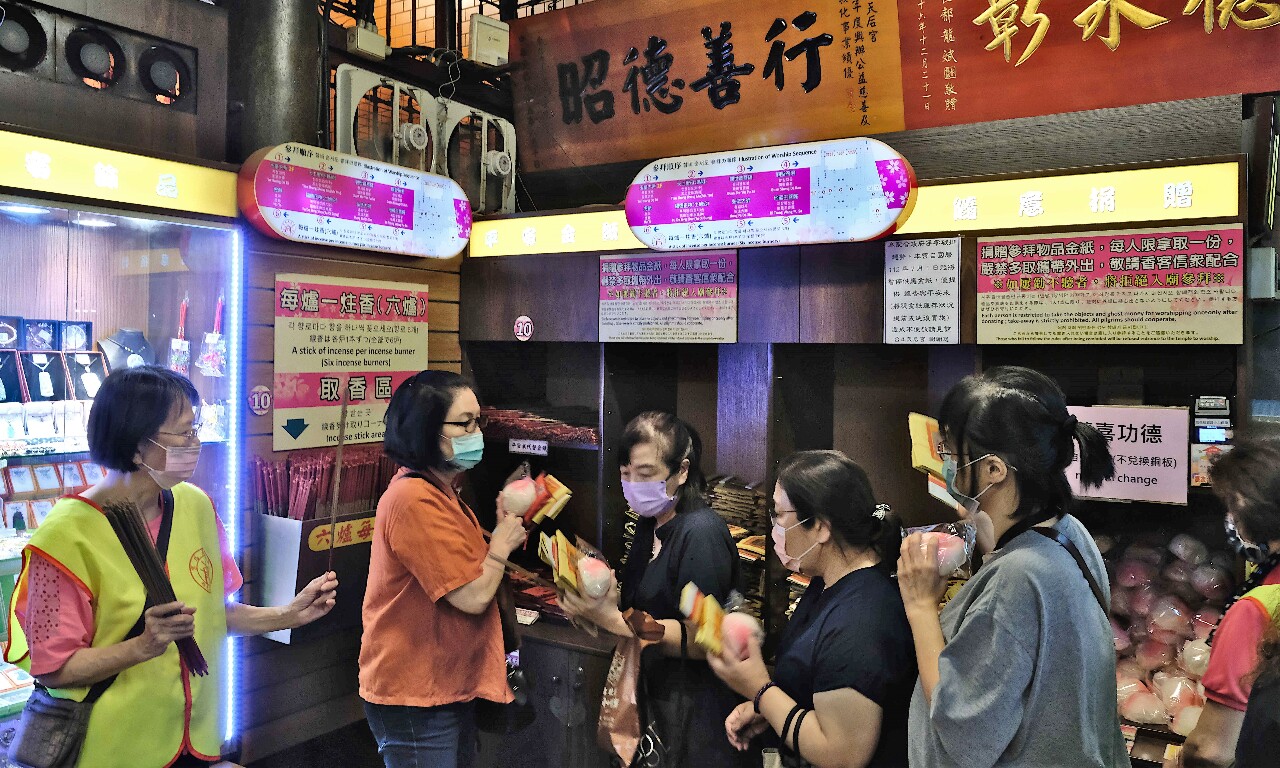
The Taipei Tianhou Temple in Ximen has issued a notice to the public that it will stop supplying visitors with offerings of spirit money beginning Saturday, July 1. According to a worker at the temple, the decision was achieved by consensus from the temple’s management committee with encouragement from the government, which aims to reduce greenhouse gas emissions.
At present, the temple, which is one of the oldest in Taipei, still gives out bundles of spirit money, incense sticks, packets of “peaceful” rice vacuum sealed in red plastic, and steamed bread wrapped in clear plastic and made to look like a peach to worshipers at a cost. In exchange, each worshiper is expected to contribute around NT$150 (US$5) for a set of offerings.
Over the years, Tianhou Temple has taken various measures to protect the environment. These include eliminating the use of burning candles which generate heat from combustion, and reducing the volume of smoldering incense by two-thirds from 18 sticks, or three per each of the temple’s six burners, to six sticks, or one per burner.
In addition, Tianhou Temple no longer directly burns the huge stores of spirit money that accumulate on altar tables throughout the day in the furnace in the temple, but sends the items to be incinerated in a centralized facility outside the densely populated city area. Such actions have been taken out of public safety and pollution concerns from the smoke released.
Despite the benefits that “green worship” provides residents, however, attitudes are difficult to change and efforts to foster more environmentally sustainable forms of veneration have met with opposition from some members of the religious community. Reasons for this are manifold.
Within the temple grounds, donations collected from visitors for ritual paraphernalia such as votive currency generate income that helps finance ceremonies, festivals, and other key activities and expenses. In addition, the offerings themselves have meaning, and, as was the case when candles were banned, without spirit money some people will be persuaded from going to temple at all.
Outside the temple grounds, religious places are an important source of livelihood for enterprises in the surrounding vicinity. Notably, Tianhou Temple still supplies a more traditional gold paper money that has been largely crafted by hand from one of the few remaining makers in Taiwan.
Funds, followers, and traditions enable faith spaces to exist, and the potential losses that these sacred sites face must be balanced with environmental protection. Tianhou Temple’s difficult decision to stop dispensing spirit money in order to meet the current net zero emissions target is therefore important, and shows that changes in rituals will be incremental, gradual, and constrained.