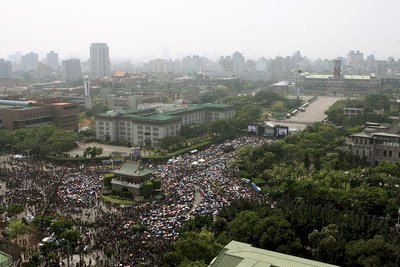
Hundreds of thousands of protesters took to the streets of Taipei on Sunday in support of the Sunflower Movement, a movement launched by student activists, which led to the occupation of Taiwan’s legislature nearly two weeks ago.
At the heart of the protests is a trade in services agreement with China, which the government signed last June. The activists are critical of the agreement, which they say was negotiated behind closed doors, and could give China too much control over Taiwan.
On Sunday afternoon, police estimates put the number of protesters at 116,000 people. Local media gave much higher estimates in the hundreds of thousands.
Student leader Lin Fei-fan estimated that the crowd had reached 500,000 people, and demanded President Ma Ying-jeou respond immediately to the protesters’ four requests.
Those requests include: retracting the cross-strait trade in services agreement; the legislation of a new law that would allow for closer legislative monitoring of future agreements with China; a cross-partisan conference with representatives from all sectors of society; and support for a bill drafted by civic groups, which addresses the process for signing pacts with China.
Sunday’s protest saw crowds of people dressed in black, with many people holding sunflowers, which have become a symbol of the movement. Organizers were urging protesters not to bring unrelated signs or weapons, and to remain peaceful. A group of several hundred volunteers was on hand to direct the crowd and help ensure the protest unfolded peacefully.
Participants had largely left the scene by shortly after 8pm, about an hour after the protests were scheduled to conclude. Some people moved on to the legislature, where the original core group of protesters is still occupying the building.
During a speech at the conclusion of the demonstration on Sunday night, student leader Lin Fei-fan said that the demonstration was only the beginning. He urged participants to get the contact information of seven other people in the crowd, and arrange rotating schedules for participating in the continued protests at the legislature.